Best Shelving Units for Woodworkers by Load Capacity

A woodworker's shelves carry hardwood offcuts, planers and cast-iron accessories. Five racks compared on load, depth and height so the right one lands in your shop.

By Raylee LynchUpdated 15 min read
On this page
- Best shelving unit for woodworkers at a glance
- How I narrowed a long list down to five
- What actually decides a shop shelf?
- 1. SAMRELAX Garage Shelving Unit 72" x 36" x 16" — Best overall
- 2. REIBII 3200LBS Storage Shelves 55.5" W — Best premium
- 3. AOAORGG 71.2" H Garage Shelving — Best upgrade
- 4. Amazon Basics 4-Shelf Steel Wire Shelving — Most versatile
- 5. Plano 4-Shelf Plastic Storage Shelves — Best budget pick
- Wire deck or MDF deck: which suits lumber?
- Depth, height and the space above the bench
- What to check before you click buy
- The verdict
- FAQ
The best shelving unit for woodworkers is the SAMRELAX 72" x 36" x 16" rack, because 400 lb per tier over five tiers is what a shop actually needs when a jointer fence, a box of chisels and a stack of hardwood scraps all want the same spot. If your wall run is wider and your load heavier, the REIBII 55.5" W wire unit is rated to 3200 lb across five tiers and stages long boards better. Everything else in this guide is a different answer to a different shop.
Best shelving unit for woodworkers at a glance
| Pick | Height × Width × Depth | Load rating | Price |
|---|---|---|---|
Best overall SAMRELAX 72" x 36" x 16" |
72 x 35.55 x 16 in | 400 lb per tier claim 2000 lb total claim |
Check Price |
Best premium REIBII 3200LBS 5-Tier Wire Shelving |
71 x 55.5 x 18 in | 3200 lb total claim | Check Price |
Best upgrade AOAORGG 71.2" H 5-Wire Rack |
71.2 x 35.4 x 15.7 in | Not published | Check Price |
Most versatile Amazon Basics 4-Shelf Wire |
48 x 23.2 x 13.4 in | 200 lb per shelf 800 lb total |
Check Price |
Best budget pick Plano 4-Shelf Plastic Storage |
47.5 x 23 x 14 in | 50 lb per shelf 200 lb total |
Check Price |



A quick note on the search that brought you here. Amazon returned general garage and pantry shelving for the phrase, not woodworking-specific storage. None of these five is sold as a lumber rack. What follows treats them as shop candidates and compares them on the specs that actually matter when the load is dense and awkward.
How I narrowed a long list down to five
Three cuts. First cut: anything with a per-shelf rating below 50 lb, because a single cordless drill, a battery and a case can hit that number. Second cut: anything under 48 inches tall, since a shop shelf that ends at bench height wastes the vertical space you were paying rent on. Third cut: units where the published dimensions did not include depth, because a rack you cannot walk past is a rack you resent.
That left the five here. Four are steel, one is plastic. Three top out around 71 inches and give you five tiers; two are shorter four-tier units for tighter walls or lower ceilings. The best shelving unit for woodworkers in each footprint is the one carrying the most weight, per tier, on the deepest deck that still clears your walkway.
The picks split cleanly by shop size. A 55-inch-wide wire unit belongs on a long garage wall. A 35-inch-wide unit fits between a workbench and a door swing. A 23-inch-wide unit is for the back of a basement shop or the corner where finishes live. Match footprint first, then load.
What actually decides a shop shelf?
Most guides compare height. Height is the easy number and it is not the deciding one. Load per tier is.
A woodworker's shelves carry dense, uneven weight: a router in its case, a spare fence, a bag of dominoes, a bin of drawer pulls, a stack of plywood cutoffs waiting for glue-up. Two of those items on one shelf can pass 40 lb. A rack rated to 50 lb per shelf is a rack you have to think about every time you set something down.
Here is the trick with the ratings you see on the listing. Read them as manufacturer claims, not as tested capacities, and read them evenly distributed. A 200 lb shelf holding a 60 lb planer at one end is not carrying 60 lb of its rating; the point-load and the moment on the frame make the effective number lower. Buy above the load you plan for, not right at it.
The other spec that quietly decides is depth. A 13.4-inch shelf will not hold a lunch-box planer square. A 16 to 18 inch shelf will. If you own bench-top machines, 16 inches is the floor.
1. SAMRELAX Garage Shelving Unit 72" x 36" x 16" — Best overall
The SAMRELAX rack is the pick because 400 lb per tier over five tiers, on a 16-inch deep MDF deck, is the closest thing in this set to shop-grade storage.
Best for: a two-car garage shop storing hand tools, hardware bins and short offcuts Skip it if: you need to park a 60 lb planer on a single shelf
Height gets you five usable tiers at 72 inches, and the 35.55-inch width sits neatly between studs on a typical garage wall. SAMRELAX puts a 400 lb per-tier claim on the listing, backed by what they describe as a Z-frame with 0.9mm rolled-edge columns and 0.6mm supports. Read those figures as the manufacturer's claim and derate them for point loads: I would happily rest a router table on it, and I would not stack cast iron.
The 16-inch depth is what pushes this pick over the wire options with 13 to 15 inch decks. A bench-top planer, a benchtop drill press base, a domino case in its systainer, a bin of clamp heads: they all sit square on 16 inches, and none of them do on 13. The MDF deck also stops small parts falling through, which is the quiet reason a woodworker wants a solid deck over wire when the shelf is holding screws, drill bits and pencils.
The trade-off against the REIBII is width. You get less linear shelf, and no published total-load figure to match the REIBII's 3200 lb claim.
Pros:
- 400 lb per tier claim across five tiers
- 16-inch deep deck fits bench-top machines
- MDF surface stops small parts falling through
- 72-inch height uses full wall
- Second-cheapest in this set
Cons:
- No published warranty
- MDF deck can swell if the shop leaks
- One seller lists it, so returns route through a single source
2. REIBII 3200LBS Storage Shelves 55.5" W — Best premium
The REIBII is the pick when your shop wall is wide and the loads are cast iron.
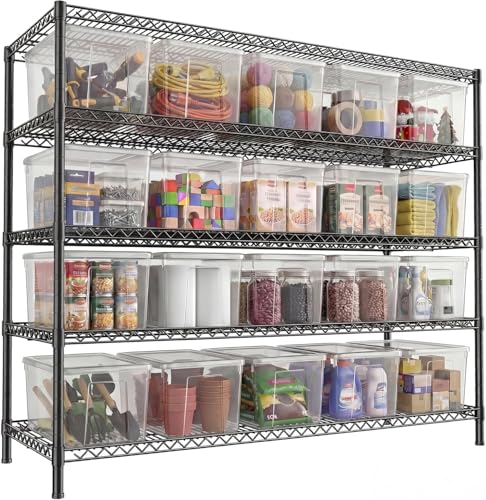
Best for: a busy shop with cast-iron accessories and long boards to stage Skip it if: your wall run is under 56 inches
Two numbers do the work here. 55.5 inches of width means a five-foot board rests on the shelf instead of hanging off it, and 18 inches of depth clears almost any bench-top machine base. REIBII quotes 3200 lb total across five tiers, using 25mm metal rods and what they call three V-type reinforced braces. Attribute the number to the listing; even at half that, this is the sturdiest option in the group.
The wire deck is the honest compromise. Screws, drill bits and small hardware fall through open wire, so this unit wants bins rather than loose parts. On the plus side, sawdust drops through instead of settling, which is exactly the behaviour you want on a shelf that lives near a table saw.
The premium position in this set buys you width and reinforcement, not extra tiers. You still get five, same as the SAMRELAX and the AOAORGG. What you gain is the ability to stage a whole cabinet's worth of parts on one shelf without playing Tetris. What you lose is footprint: this rack needs a real wall.
Pros:
- 3200 lb total claim across five tiers
- 18-inch deep decks clear bench-top machines
- 55.5-inch width stages five-foot stock
- Wire deck sheds sawdust and lets dust pass through
- V-brace reinforcement on each tier per the listing
Cons:
- The most expensive pick here
- Small parts fall through open wire
- No published warranty
- Only one seller lists it
3. AOAORGG 71.2" H Garage Shelving — Best upgrade
The AOAORGG earns its place as the shallow-depth five-tier option, at 15.7 inches deep with a 35.4-inch width that mirrors the SAMRELAX footprint.

Best for: a tidy home shop that wants a full-height rack in a shallow footprint Skip it if: you want a published per-shelf load number in writing
The specs put this unit almost on top of the SAMRELAX for external size, at 71.2 x 35.4 x 15.7 inches versus 72 x 35.55 x 16. What separates them is deck type and disclosure. AOAORGG uses steel wire and does not publish a per-tier or total load figure. The listing talks about high-quality metal construction and hassle-free assembly. Attribute those as claims and plan around the missing numbers.
The upgrade angle is the walkway. Half an inch of depth sounds trivial until you are trying to slide past the rack with a piece of sheet goods on your shoulder. The 15.7-inch shelf takes bench-top machines and clamp bins without swallowing your aisle.
Against the REIBII, this pick trades width and a load figure for a smaller footprint. Against the SAMRELAX, it trades a solid MDF deck for open wire and a lighter unit at 30 lb assembled. Choose it when the wall is narrow and you would rather have five wire tiers than four.
Pros:
- Five tiers at 71.2 inches tall
- 15.7-inch depth suits narrow walkways
- Adjustable shelf heights per the listing
- Matches the SAMRELAX footprint to the half-inch
Cons:
- No published load rating per shelf or total
- No published warranty
- Wire deck lets small parts fall through
- Only one seller lists it
4. Amazon Basics 4-Shelf Steel Wire Shelving — Most versatile
Amazon Basics wins on flexibility, not capacity: four tiers, 200 lb per shelf claim, 1-inch height adjustments and a 23.2-inch width that fits almost anywhere.

Best for: a shared basement shop where the rack may move to a laundry room later Skip it if: you plan to store anything longer than 23 inches on a single deck
At 48 inches tall and 23.2 inches wide, this is the small unit in the set. Amazon quotes 200 lb per shelf and 800 lb total, which is honest capacity for finishes, hand-tool cases and a couple of power-tool systainers. The four leveling feet and 1-inch shelf adjustment are the details a shop actually uses: uneven concrete is normal, and moving a shelf up an inch to clear a case lid is a weekly move.
The reason it is not higher in this ranking is scope. A woodworker's shelf earns its keep by holding awkward, long or heavy things. 23.2 inches of width will not stage a 4-foot board or a mitre saw. 13.4 inches of depth will not seat a bench-top planer square.
What it does well is double duty. Assemble it in the basement shop today, move it to the laundry room in two years, and it still works. That is the versatility the label points to, and it is a real advantage in a rented space.
Pros:
- 200 lb per shelf claim and 800 lb total
- 1-inch shelf adjustments across four tiers
- Four leveling feet for uneven floors
- Tool-free assembly per the listing
- Two sellers list it
Cons:
- 13.4-inch depth is too shallow for most bench-top machines
- 48-inch height leaves the top of the wall empty
- Wire deck lets small parts fall through
- Four tiers, not five
5. Plano 4-Shelf Plastic Storage Shelves — Best budget pick
Plano is the pick for finishes and consumables, not for heavy shop gear.

Best for: finishes, glues, sandpaper and small hardware in a home shop Skip it if: you want to stack anything over 50 lb on a single shelf
A woodworking shop is 20% machines and 80% supplies. This rack is for the 80%. Plano quotes 50 lb per shelf across four shelves and a 200 lb total, which is enough for gallons of finish, boxes of sandpaper, glue bottles, tape, a shop vacuum bag stash and the small stuff that overflows every drawer. The cheapest of the five here, by a clear margin.
Plastic construction is the argument for and against. For: finishes drip, water spills, and plastic wipes clean where steel rusts. Against: point loads can crack plastic that a steel frame would shrug off, and each shelf tops out at 13 inches of clearance, so anything taller has to go on the top.
The interlocking feature on the listing is worth noting. If your consumables outgrow one unit, another slots in beside it without hardware. That does not make it a machine shelf, and Plano does not pretend it is. Buy this for the finishes corner and buy something else for the machines.
Pros:
- Cheapest in this set
- Impact-resistant plastic wipes clean
- Tool-free assembly per the listing
- Interlocking design for expansion
- 8 lb total, easy to move solo
Cons:
- 50 lb per shelf, the lowest here
- 13.4-inch depth is shallow for shop use
- 13-inch tier clearance limits tall items
- 47.5-inch height leaves upper wall unused
Wire deck or MDF deck: which suits lumber?
Deck type is the other quiet decision. Four of the five picks are open wire; the SAMRELAX is the only MDF deck in the set. Neither is universally better, and the right answer depends on what lives on the shelf.
Wire wins for airflow, sawdust and long boards. Chips fall through the deck instead of piling up. A board resting across two wire shelves can span the whole rack without sagging into a solid surface. Wire also weighs less, which matters if you ever have to move the assembled unit through a doorway.
MDF wins for small parts and finishes. Screws stay put. Cans of finish sit flat. A router base does not rock on wire. The trade-off is moisture: an MDF deck in a damp basement will swell at the edges over a couple of winters. If your shop floor gets damp, seal the edges with polyurethane before you load the rack, and keep the bottom shelf a few inches off the floor.
Some shops mix. Wire on the top three tiers for boards and bins, MDF on the bottom two for finishes and hand tools. None of the five here ships that way out of the box, but a strip of thin ply cut to the shelf size drops onto a wire deck and gives you the same effect for a couple of dollars.
Depth, height and the space above the bench
Two shop measurements decide which of these fits before load ever enters the conversation.
- Depth of the walkway behind the rack. If the rack sits against a wall and you walk past it with sheet goods, you want at least 30 inches of clear aisle. Subtract the rack depth from your total floor depth and check the number is a real 30 inches, not 27.
- Height clearance above the top shelf. A 72-inch rack in a garage with a 96-inch ceiling leaves 24 inches for lighting, storage bags and any ductwork. Check the ceiling before you order the tallest unit.
- Bench height at the rack's neighbour. If the rack sits next to a bench, align a tier with bench height so you can slide a case straight from bench to shelf. All three tall picks are adjustable, so this is a setup choice, not a purchase one.
A common mistake is buying the tallest rack that clears the ceiling and then losing the top shelf entirely, because you cannot reach it without a stool. Better to leave 12 to 18 inches above the rack and keep every tier in reach. Five tiers you use beat six tiers where the top one collects dust.
What to check before you click buy
Six things worth confirming on the listing before you order, because none of them are universal across this set:
- Assembled weight versus shipping weight. A 30 lb rack ships in a longer box than an 8 lb rack; measure your car if you plan to pick it up.
- Tool requirements. Two of the picks describe tool-free assembly; the rest do not commit either way. Have a rubber mallet nearby regardless.
- Adjustment increments. 1-inch adjustment beats 2-inch, and 2-inch beats fixed. Only the Amazon Basics unit puts the increment in writing.
- Foot type. Leveling feet matter on concrete. Casters change the whole calculus if you want to roll the rack out for shop cleaning.
- Deck retention. A wire deck that sits in place is fine; one that clips down is better if the shop gets bumped.
- Total assembled height. Ceiling clearance is what stops you tilting the rack up after assembly. Assemble it upright if the ceiling is tight.
The verdict
The best shelving unit for woodworkers is the SAMRELAX 72" x 36" x 16", because it is the only rack in this set that pairs a 16-inch deep solid deck with a 400 lb per-tier claim and five tiers of 72-inch height. Small parts stay put, bench-top machines sit square, and the footprint fits a normal garage wall. That combination is what a shop actually needs from a shelf.
Two conditions flip the pick. First, if your wall is wider than 56 inches and your storage runs to cast-iron accessories, the REIBII 3200LBS is the better buy: 55.5 inches of shelf, 18 inches of depth, and a total-load claim that dwarfs the SAMRELAX's. Second, if your shop is a rented basement corner and the rack needs to move later, the Amazon Basics 4-Shelf is the honest answer, because 48 x 23.2 x 13.4 inches goes anywhere and 200 lb per shelf covers consumables.
The AOAORGG suits a narrow walkway with no published load figure. The Plano is for the finishes corner, not the machine corner. Match footprint, then load, then deck type, in that order.
FAQ
Is a wire shelving unit strong enough for woodworking tools?
A wire shelving unit is strong enough for most woodworking tools if you match the per-shelf rating to the heaviest single item. The REIBII quotes 3200 lb total across five tiers and the Amazon Basics quotes 200 lb per shelf. Both figures are manufacturer claims, so derate for point loads: a 60 lb planer on one corner uses more of the rating than 60 lb of loose hand tools spread across the deck.
What shelf depth do I need for bench-top machines?
Shelf depth for bench-top machines starts at 16 inches, because most lunch-box planers, benchtop drill presses and router tables sit on a base that is 14 to 15 inches front-to-back. The SAMRELAX at 16 inches and the REIBII at 18 inches clear that comfortably. The Amazon Basics at 13.4 inches and the Plano at 14 inches do not, so those two units are for cases, bins and consumables rather than machines.
SAMRELAX or REIBII: which is the better shop shelf?
SAMRELAX or REIBII comes down to wall width and deck type. Pick the SAMRELAX if your run is around 36 inches wide and you want a solid MDF deck for small parts and finishes; the 400 lb per-tier claim covers most home-shop loads. Pick the REIBII if your run is 55 inches or wider and you stage long boards or cast-iron accessories; the 18-inch wire deck and 3200 lb total claim carry heavier, longer stock.
How tall a shelving unit fits under a garage ceiling?
Tall a shelving unit can safely be while still fitting a garage ceiling is your ceiling height minus about 18 inches. That leaves clearance to tilt the rack up after assembly and room above the top shelf for lighting or ductwork. The three tallest picks here run 71 to 72 inches, so an 8-foot ceiling is fine. In a basement with 84-inch clearance, the 48-inch Amazon Basics or Plano units are the safer buy.
Is the Plano plastic shelving unit worth it for a shop?
Plano plastic shelving is worth it in a shop as a finishes rack, not a machine rack. 50 lb per shelf handles gallon cans, glue bottles, sandpaper boxes and small hardware. Plastic wipes clean when finish drips, where a wire deck traps drips in the mesh. Skip it for anything heavier: a router in a case plus a spare fence can pass the shelf rating, and plastic cracks under point loads that steel would absorb.
Start with the footprint. Measure the wall you plan to fill, subtract 30 inches for walkway on any side you use to walk past sheet goods, and pick the widest rack that still leaves that clear. If a 55-inch REIBII fits, it is the shelf that stops you buying a second unit in a year. If the wall is closer to 36 inches, the SAMRELAX is the honest default because a 16-inch solid deck and a 400 lb per-tier claim cover what a woodworker actually piles on a shelf. The two shorter picks are supporting cast, not headliners. Order the tall rack first and let the finishes corner wait.