Best Garage Shelving Units by Load and Depth

Five metal garage shelving units compared by height, depth, and published load claims, with a clear winner for the pro who has to fit real weight into real space.

By Raylee LynchUpdated 13 min read
On this page
- Best garage shelving unit for professionals at a glance
- How I scored these five units
- What actually decides a garage shelf?
- How deep does a pro shelf need to be?
- 1. Sakugi Storage Shelves — Best overall
- 2. SISESOL 71.3" Wide Heavy Duty Garage Shelving Units — Best premium
- 3. REIBII 3200LBS Storage Shelves 55.5" W Garage Shelving — Best for families
- 4. AOAORGG 71.2" H-35.4" W Garage Shelving Heavy Duty Storage — Most versatile
- 5. SAMRELAX Garage Shelving Units Shelves for Garage Storage — Best upgrade
- Reading a load rating without getting fooled
- When a different pick wins
- The verdict
- FAQ
The best garage shelving unit for professionals is the Sakugi Storage Shelves, a 72.0 in tall five-tier rack that stands full height in a 12.6 in deep footprint and weighs just 17.6 lb. If your parts run bulky and you need real reach, the SISESOL at 24 in deep and 80 lb is the better buy. Here's the misconception worth clearing first: most buyers compare printed load numbers. That is not what decides this. Depth and footprint decide whether the unit even fits your bay, and only then does weight matter.
Best garage shelving unit for professionals at a glance
| Pick | Depth × Height | Load claim | Price |
|---|---|---|---|
Best overall Sakugi Storage Shelves |
12.6 in × 72.0 in | not published | Check Price |
Best premium SISESOL 71.3" Wide Heavy Duty |
24 in × 70 in | 5000LBS claim | Check Price |
Best for families REIBII 3200LBS 55.5" W |
18 in × 71 in | 3200LBS claim | Check Price |
Most versatile AOAORGG 35.4" W |
15.7 in × 71.2 in | not published | Check Price |
Best upgrade SAMRELAX 72" × 36" |
16 in × 72 in | 2000LBS claim | Check Price |




How I scored these five units
I set the criteria before I ranked anything, and I weighted them for a working garage rather than a spare bedroom. Here is what mattered, in order.
- Fit. Depth and footprint first. A unit that won't clear your bench or your car door is useless at any load.
- Height used. All five run near 70 in tall, so vertical space is roughly a wash. That freed me to weight depth harder.
- Load evidence. Where a load claim exists, I treat it as the manufacturer's claim, not a measured fact. Units with no published figure lose points for that gap, not for weakness.
- Portability. Shipping weight tells you how hard the thing is to reposition once built.
Then the weights. Fit counted most because it's the one thing you cannot fix after purchase. Load evidence counted next. Portability broke ties. That is why the Sakugi wins despite publishing no load number: at 12.6 in deep it fits bays the wider units block, and at 17.6 lb one person can shift it. The best garage shelving unit for professionals has to earn its floor space first.
What actually decides a garage shelf?
Most guides lead with the load rating. That's the wrong anchor. A load claim is the manufacturer's claim, spread across the whole unit, under ideal centered loading you will never replicate. It tells you little about the bin of fasteners you actually park on tier three.
What decides the purchase is geometry. Depth sets whether long tools lie flat. Footprint sets whether the unit shares a wall with your workbench. Height is nearly equal across this set, from 70 in on the SISESOL to 72.0 in on the Sakugi.
Here is the deciding split in this field:
- Narrow depth, 12.6 to 16 in: Sakugi, AOAORGG, SAMRELAX. Best against a wall in a tight bay.
- Deep, 18 to 24 in: REIBII and SISESOL. Best for bulky bins and boxed inventory.
Pick your depth band first. Everything else is secondary.
How deep does a pro shelf need to be?
Depth is the number a pro should decide before touching a load figure. It governs what fits and how far you reach.
- 12.6 in (Sakugi): shallow. Holds paint, small parts, standard tote boxes. Won't swallow a deep bin.
- 15.7 in (AOAORGG): a mid depth that suits mixed clutter without eating your walkway.
- 16 in (SAMRELAX): similar reach, with solid MDF decking instead of open wire.
- 18 in (REIBII): roomy enough for storage totes stored front-to-back.
- 24 in (SISESOL): the deepest here, built for bulk. It also projects two full feet from the wall, so measure your clearance twice.
A deeper shelf stores more but steals floor. In a two-car garage with a car parked, the deep units force you to walk sideways. In a workshop bay with open floor, depth is pure gain. Match the depth to the space, not to the biggest number on the listing.
1. Sakugi Storage Shelves — Best overall
A full-height five-tier rack that stands in a 12.6 in footprint and still lets one person move it.
Best for: a pro who wants a full-height unit in a narrow bay Skip it if: you need to store 24 in deep bins
The Sakugi wins on fit. At 12.6 in deep it is the shallowest unit here, which is exactly why it slots against a wall where the 24 in SISESOL would block your walkway. It reaches 72.0 in tall across five tiers, the full height of this set, so you lose nothing vertically for gaining floor space. The footprint measures 33.0 in wide.
At 17.6 lb it is by a wide margin the lightest unit here, less than a quarter the weight of the SISESOL. That means one person can build it, reposition it, and level it on an uneven slab. Sakugi points to leveling feet and calls the tubes 0.9 in in diameter, and describes what it calls double stabilization. Treat those as the maker's claims.
It is the cheapest of the five and the one buyers here choose most often. The trade-off is honest: no published load figure, and the shallow depth rules out deep bins. For a pro storing paint, parts, and standard totes in a tight space, that trade is easy.
Pros:
- Shallowest depth here at 12.6 in
- Full 72.0 in height across five tiers
- Lightest unit at 17.6 lb, one-person setup
- Cheapest of the five
- Leveling feet for uneven floors
Cons:
- No published load capacity
- 12.6 in depth too shallow for deep bins
- Narrowest storage width in the tall group
2. SISESOL 71.3" Wide Heavy Duty Garage Shelving Units — Best premium
The deepest, heaviest unit here, built for bulk parts and for linking multiple runs along a wall.

Best for: storing bulky parts and connecting multiple runs Skip it if: your bay is tight or you move often
The SISESOL is the depth answer. At 24 in deep it swallows storage totes front-to-back that the narrow units can't hold, and at 71.3 in wide it gives the broadest run in the set. It stands 70 in tall in matte black. This is the unit for a pro who thinks in boxed inventory rather than loose parts.
It is also the most substantial thing here at 80 lb, more than four times the Sakugi. That weight signals thicker steel, but it also means two people and a plan for assembly. SISESOL claims a 5000LBS load, the highest number in this set, plus eight reinforced lateral bars and an interconnectivity feature that lets units link together. Those are the maker's claims, and the linking feature is the real reason to pick this over the REIBII if you're building a wall of storage.
It sits at the top of the price range here. The trade-off: at 24 in deep it projects two feet from the wall, and at 80 lb it does not move once built. Wrong for a tight bay, right for an open workshop.
Pros:
- Deepest bays here at 24 in
- Widest run at 71.3 in
- Units link together, per SISESOL
- Highest published load claim, 5000LBS
- Eight reinforced lateral bars claimed
Cons:
- Heaviest at 80 lb, needs two people
- 24 in depth projects far into the room
- Top of the price range here
3. REIBII 3200LBS Storage Shelves 55.5" W Garage Shelving — Best for families
A wide, mid-depth unit that splits the difference between household storage and garage loads.
Best for: a wide wall with mixed household and garage loads Skip it if: you need shelf weight figures published
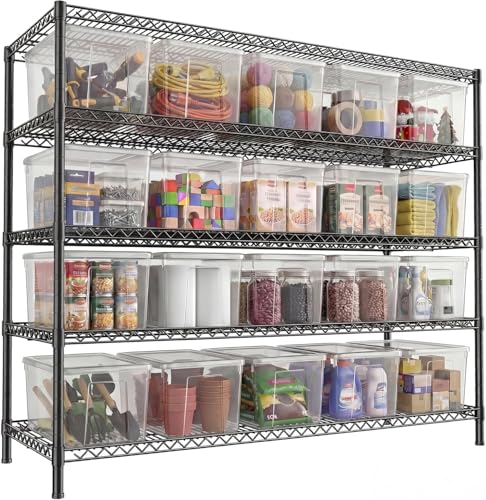
The REIBII is the middle-ground pick on depth, at 18 in, which is deep enough for storage totes without the 24 in reach of the SISESOL. It runs 55.5 in wide and 71 in tall across five tiers, so a family can dedicate tiers to sports gear, seasonal bins, and garage parts on one unit. It ships in black.
REIBII claims a 3200LBS capacity with three V-type reinforced braces and 25mm diameter rods, plus vertical shelf adjustment and a powder coating for rust resistance. Read those as the maker's claims. The adjustable tiers matter for a mixed load: you can set one tall gap for a bin and pack the rest tight.
It sits in the upper part of the price range here. The honest weakness is thin published data. Beyond size and the load claim, the listing gives no shipping weight and no model detail, so you're buying more on the maker's word than with the Sakugi or SISESOL. For a wide wall serving a whole household, the width and adjustability still carry it.
Pros:
- Roomy 18 in depth for totes
- Wide 55.5 in run for mixed loads
- Adjustable tier heights
- 3200LBS load claimed with V-braces
- Powder coating for rust resistance, per REIBII
Cons:
- No published weight or model detail
- Upper price range here
- Load figure is a claim, not measured
4. AOAORGG 71.2" H-35.4" W Garage Shelving Heavy Duty Storage — Most versatile
A mid-depth, mid-weight unit light enough to move between rooms without a second person.

Best for: moving a unit between garage, pantry, and basement Skip it if: you want the widest footprint here
The AOAORGG is the flexible pick. At 15.7 in deep and 35.4 in wide it lands between the shallow Sakugi and the deep units, so it suits a garage today and a pantry next year. It stands 71.2 in tall across five wire tiers in black. Nothing about its footprint locks it to one room.
At 30 lb it is the middle weight here, roughly a third the SISESOL and heavier than the Sakugi. One determined person can still relocate it, which is the whole point of a versatile unit. AOAORGG describes precision-engineered metal and quick assembly with a full component set, and stresses stability against wobble. Those are the maker's claims, not measured results.
It sits mid-range on price. The trade-off is that it commits to nothing in particular: no published load figure like the REIBII, no 24 in depth like the SISESOL, no MDF decking like the SAMRELAX. It is the generalist. If you know you need one specific thing, another pick beats it. If you value the freedom to move a unit around, it's the one to buy.
Pros:
- Balanced 15.7 in depth for mixed use
- Moderate 30 lb weight, one-person move
- Full 71.2 in height, five tiers
- Mid-range price here
- Open wire tiers shed dust
Cons:
- No published load capacity
- Narrower than the REIBII and SISESOL
- Commits to no standout feature
5. SAMRELAX Garage Shelving Units Shelves for Garage Storage — Best upgrade
Solid MDF decking instead of open wire, for parts too small to trust to a grid.

Best for: someone who wants solid MDF decking, not open wire Skip it if: you want the lightest unit to reposition often
The SAMRELAX is the decking upgrade. Where the other four rely on open wire grids, SAMRELAX specifies 5mm high-density MDF tiers, which give a flat surface that won't drop washers, fasteners, or loose bits through the gaps. It stands 72 in tall, ties the Sakugi for the tallest here, at 16 in deep and 35.6 in wide in matte black.
SAMRELAX claims a Z-frame with 0.9mm columns supporting 400lbs per tier, which works out to a 2000LBS load claim, plus drop-test certified packaging. Take those as the maker's claims. The solid tiers are the real reason to choose it: for small-parts organizing, a flat deck beats a grid every time.
It's the second-cheapest here, and among the slowest sellers in this set. At 34.8 lb it's near the heavy end, so it's not the one you shuffle around weekly. The trade-off against the Sakugi is weight and depth for the sake of that solid decking. If your storage is bins and boxes, the wire units are lighter and cheaper. If it's loose hardware, the deck earns its place.
Pros:
- Solid 5mm MDF decking, not wire
- Ties tallest here at 72 in
- Second-cheapest of the five
- Z-frame with 2000LBS claim
- Matte black powder-coated frame
Cons:
- Heavier at 34.8 lb than the Sakugi
- 16 in depth still modest
- Among the slowest sellers here
Reading a load rating without getting fooled
Three of these units print a big load number and two print none. Do not let the number decide for you.
A load claim like 5000LBS or 3200LBS is a manufacturer's claim for the whole unit, split across five tiers, under evenly centered weight. In a real garage you load one tier heavy and off-center. The usable per-shelf figure is a fraction of the headline. SAMRELAX is the only one that states its math, calling out 400lbs per tier.
Use these rules when you read a listing:
- Divide the total claim by the tier count for a rough per-shelf figure.
- Assume centered, even loading; treat edge loads as much lower.
- A missing figure, as on the Sakugi and AOAORGG, is a data gap, not proof of weakness.
- Anti-corrosion and powder coating claims speak to lifespan, not strength.
The best garage shelving unit for professionals is the one whose depth and footprint fit first, with a load claim that clears your real need by a wide margin.
When a different pick wins
The Sakugi is the default. But the right unit flips on your bay and your load. Here are the thresholds.
- If your bays run deep and open, the SISESOL wins. At 24 in deep it holds boxed inventory the Sakugi can't, and units link into a wall.
- If one wall serves the whole household, the REIBII wins. Its 55.5 in width and adjustable tiers spread sports gear, bins, and parts across one run.
- If you'll relocate the unit between rooms, the AOAORGG wins. At 30 lb and 15.7 in deep it moves and adapts without fuss.
- If you store loose hardware, the SAMRELAX wins. Solid MDF decking stops small parts falling through a wire grid.
Match the flip to your situation. Fit and load type decide more than any headline number.
The verdict
If your space is tight, the Sakugi Storage Shelves is the best garage shelving unit for professionals. At 12.6 in deep it fits a narrow bay against a wall, stands the full 72.0 in tall across five tiers, and at 17.6 lb one person builds and moves it. It is also the cheapest here. It wins because it clears the one hurdle you can't fix later: it fits.
The cutoff is depth. If your bays run deeper than 18 in and stay open, the SISESOL is the pick. Its exact advantage is reach and scale: 24 in deep bays hold boxed inventory the Sakugi cannot, 71.3 in of width per unit, and an interconnectivity feature that links multiple units into a continuous wall of storage. It also carries the highest published load claim in the set, 5000LBS, and the thickest build at 80 lb. The price is footprint and weight: it projects two feet into the room and needs two people to assemble. Below 18 in of usable depth, buy the Sakugi. Above it, with floor to spare, buy the SISESOL. Everything between those two is a matter of width, decking, or portability, covered by the other three picks.
FAQ
Is a garage shelving unit worth it for a pro?
A garage shelving unit is worth it for a pro who loses time hunting for tools and parts on the floor. Five tiers of vertical storage across a 70 to 72 in frame turns a cluttered bay into searchable rows. The Sakugi does this in just 12.6 in of depth, so you gain organization without giving up floor space.
What decides the best garage shelving unit for professionals?
What decides the best garage shelving unit for professionals is fit before load. Depth and footprint set whether the unit clears your bench and car; only then does capacity matter. Depth here ranges from 12.6 in on the Sakugi to 24 in on the SISESOL. Pick your depth band first, match a load claim second, and portability breaks the tie.
How much weight can these shelves actually hold?
How much weight these shelves hold is a manufacturer's claim spread across all five tiers under centered loading. SISESOL claims 5000LBS, REIBII 3200LBS, and SAMRELAX 2000LBS, which it breaks down to 400lbs per tier. The Sakugi and AOAORGG publish no figure. Divide any total by five for a rough per-shelf number, and treat off-center loads as much lower.
Should I choose the Sakugi or the SISESOL?
Choosing the Sakugi or the SISESOL comes down to depth. The Sakugi is 12.6 in deep and 17.6 lb, so it fits a narrow bay and one person moves it. The SISESOL is 24 in deep and 80 lb, built for bulky bins and linking into a wall. Tight space, pick Sakugi. Open floor and boxed inventory, pick SISESOL.
Does the "professionals" label mean commercial-grade shelving?
The "professionals" label does not guarantee commercial-grade certification here. These are consumer garage units marketed for workshops and basements, and the listings carry no commercial rating you can verify. Judge each one on its own published figures: depth, height, weight, and any stated load claim. If you need certified industrial racking, confirm the specification with the seller before buying.
Measure your bay before you buy anything. Note the depth you can spare against a wall and the clearance to your bench or car door, then match those two numbers to the depth column in the table above. For most pros in a shared garage, the Sakugi is the right default: it stands full height, fits where deeper units can't, and one person handles it start to finish. Buy depth for the space you have, not the space you wish you had, and the shelving disappears into the wall the way good storage should.